
ApoB: The Number Your Cholesterol Panel Leaves Out
A standard lipid panel measures how much cholesterol you carry. ApoB counts how many particles are carrying it, and in March 2026 US guidelines formally caught up with what that distinction means.
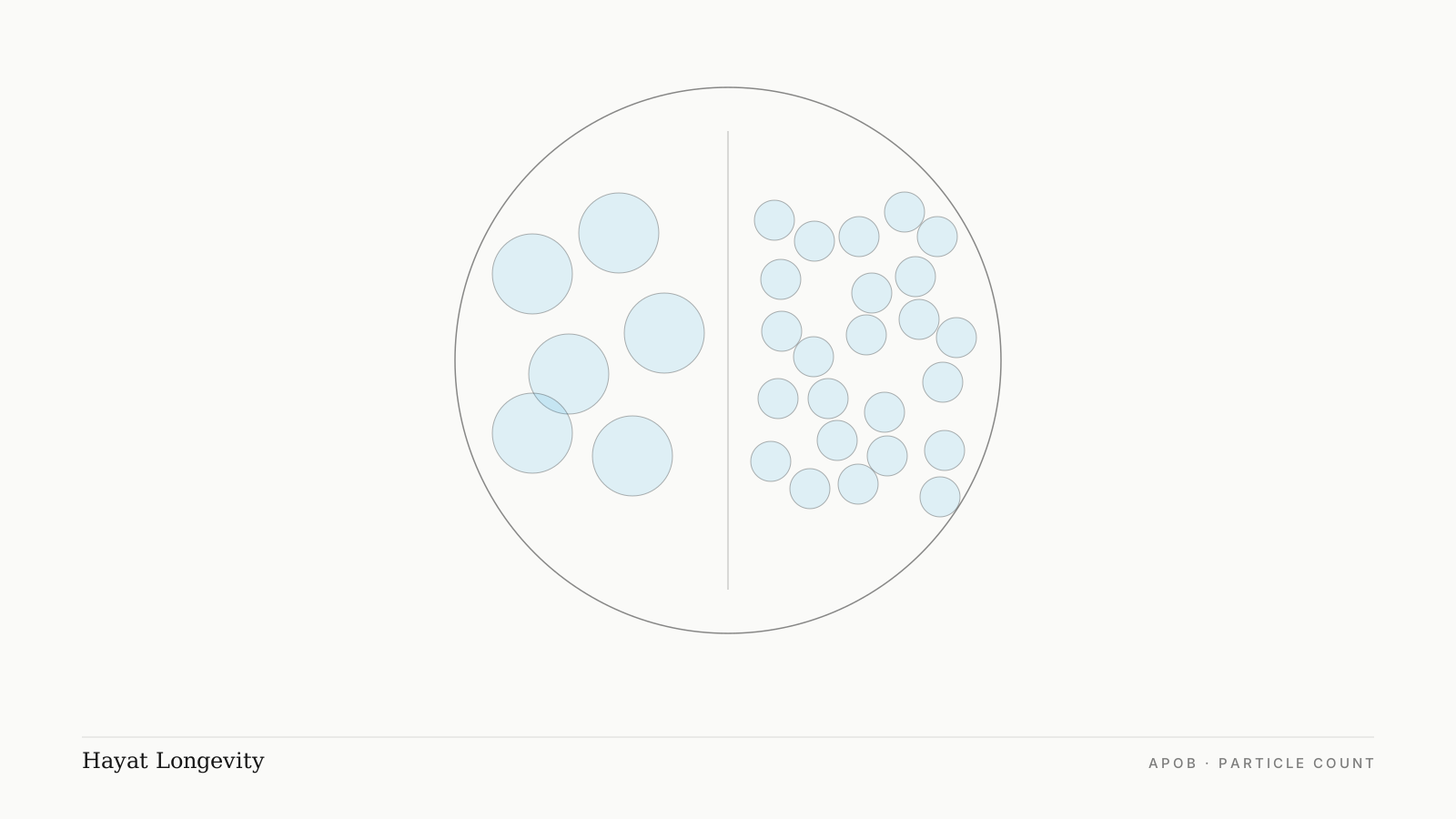
Two people can have identical LDL cholesterol on a standard panel and substantially different cardiovascular risk. Not slightly different. Substantially.
This is not a controversy or a fringe position. It follows from what the panel actually measures, and in March 2026 the American College of Cardiology and American Heart Association, alongside nine other organisations, issued their first comprehensive update to lipid guidance in eight years and formally recognised it.
The short version is that your lipid panel tells you how much cholesterol you are carrying. It does not tell you how many particles are carrying it. Those two things usually agree. When they disagree, the second one is the one that matters.
Key takeaways
- LDL-C measures cholesterol mass. ApoB counts atherogenic particles, one molecule per LDL, VLDL and Lp(a) particle.
- When the two disagree, called discordance, ApoB predicts risk more accurately. Nine of nine discordance analyses in one systematic review found ApoB superior to LDL-C.
- Discordance is most common in diabetes, metabolic syndrome and raised triglycerides, which describes a large share of the Malaysian adult population.
- The March 2026 ACC/AHA guideline formally recommends selective ApoB measurement, following Europe in 2019 and Canada in 2021.
- ApoB is directly measured rather than calculated, and is not meaningfully affected by whether you fasted.
- Lp(a) should be measured once in a lifetime. It is largely genetic and does not change with diet or exercise.
What the panel is actually measuring
Atherosclerosis begins when a lipoprotein particle crosses from the bloodstream into the artery wall and stays there. The critical detail is that entry is a function of particle number, not of how much cholesterol each particle happens to be carrying.
A standard panel reports LDL-C, which is the mass of cholesterol inside your LDL particles. It is a reasonable proxy for particle number, because in most people the two track together. Larger cholesterol load usually means more particles.
ApoB measures something different and more direct. Every atherogenic particle carries exactly one molecule of apolipoprotein B: one per LDL particle, one per VLDL, one per Lp(a). So an ApoB measurement is a particle count. It is the number of vehicles capable of depositing cholesterol into your artery wall, regardless of how full each one is.
When particles are cholesterol-poor, and there are therefore more of them for a given LDL-C, the panel understates risk. That situation has a name.
Discordance, and who it happens to
Discordance is when LDL-C and ApoB point at different levels of risk. It is not rare and it is not random.
The pattern that matters clinically is LDL-C at target while ApoB remains above target, meaning the particle burden persists even though the cholesterol number looks reassuring. According to the 2026 guideline, this is most common in people with established cardiovascular disease, cardiovascular-kidney-metabolic syndrome, diabetes, or triglycerides at or above 1.7 mmol/L, though it occurs at lower triglyceride levels too.
The evidence on which measure wins when they disagree is consistent. A systematic review of discordance analyses published in the Journal of Clinical Lipidology found ApoB superior to LDL-C in nine of nine studies, and superior to non-HDL-C in seven of nine.
Why this matters disproportionately in Malaysia. The metabolic pattern that produces discordance, raised triglycerides with insulin resistance, is exactly the pattern that is common here. Malaysia's diabetes prevalence is among the highest in the region, and our populations develop metabolic disease at lower body weights than European-derived thresholds assume, as covered in our article on visceral fat. The group in whom a standard panel is most likely to mislead is not a niche group in this country.
Consider two illustrative patients, both told their cholesterol is fine:
| Patient A | Patient B | |
|---|---|---|
| LDL-C | 2.5 mmol/L | 2.5 mmol/L |
| Triglycerides | 1.0 mmol/L | 2.6 mmol/L |
| HDL-C | 1.5 mmol/L | 0.9 mmol/L |
| ApoB | 0.75 g/L | 1.15 g/L |
| What the panel says | At target | At target |
| What ApoB says | At target | Above target |
Same LDL. Same reassurance. Different particle burden, and different risk. Patient B is the one whose panel is incomplete, and Patient B's profile is common in Malaysian clinics.
What changed in 2026
The direction of travel has been consistent for years, and the US has now joined it.
- 2019. European Society of Cardiology guidelines recognised ApoB as a superior risk marker, particularly where LDL-C underestimates risk.
- 2021. The Canadian Cardiovascular Society went further and recommended ApoB over LDL-C as the primary metric for lipid management.
- March 2026. The ACC/AHA dyslipidaemia guideline, co-authored with nine other organisations, formally recommends selective ApoB measurement to improve risk assessment and guide treatment.
The same guideline made two other changes worth knowing. Lipoprotein(a) now has a defined threshold, around 125 nmol/L, above which risk rises substantially. And women's reproductive history is included in standard cardiovascular risk assessment for the first time, which is overdue and connects directly to what we wrote about the menopausal transition.
What the numbers mean
Targets are risk-dependent rather than universal. Broadly, using European targets:
| Risk category | ApoB target |
|---|---|
| Very high risk | below 0.65 g/L |
| High risk | below 0.80 g/L |
| Moderate risk | below 1.00 g/L |
Which category you belong to is a clinical judgement involving your history, family history, blood pressure, glycaemic status and other factors. Reading your own ApoB against these numbers without that context will mislead you in one direction or the other.
Two practical advantages worth knowing. ApoB is directly measured rather than calculated from other values, so it does not inherit the estimation error that affects calculated LDL-C. And it is not meaningfully affected by fasting status, which makes it more convenient and more reliable when someone has not fasted properly, which is more often than most people admit.
The honest bit
ApoB is a refinement, not a replacement. LDL-C remains the affordable, universal foundation of lipid care, and for most people with a straightforward metabolic picture, the two agree and ApoB adds little. The 2026 guideline recommends it selectively, not universally, and that word is doing real work.
Better calculation closes some of the gap. The Martin-Hopkins method of estimating LDL-C markedly reduces discordance compared with the older Friedewald equation. Among people with LDL-C below 1.8 mmol/L calculated by Martin-Hopkins, only around 2 per cent had ApoB above guideline targets. If your laboratory uses the newer method, your LDL-C is a better proxy than it used to be. Worth asking which yours uses.
Measuring is not treating. Knowing your ApoB changes nothing by itself. What changes risk is what follows: dietary fat quality, weight and visceral fat, physical activity, and where indicated, medication. A number you collect and do not act on has cost you the price of a test.
And a caution about longevity marketing. ApoB has become fashionable in the optimisation world, and it is now sold with more certainty than the evidence supports. It is a better marker. It is not a crystal ball, and no single number captures cardiovascular risk.
Who should ask for it
On the evidence, ApoB adds most in these situations:
- Triglycerides at or above 1.7 mmol/L, where discordance is most likely
- Type 2 diabetes, prediabetes or metabolic syndrome
- Established cardiovascular disease, or an existing decision about intensifying treatment
- A family history of early cardiac events, particularly a parent or sibling affected before 55 in men or 65 in women
- A normal panel that does not match the clinical picture, which is the situation where the panel is most likely to be the thing that is wrong
- Already on lipid-lowering treatment, where ApoB assesses whether the particle burden has actually come down
If your metabolic picture is unremarkable, your triglycerides are low and your LDL-C is comfortably at target, a standard panel is probably telling you what you need to know.
What to do with the result
An ApoB above target is not a diagnosis and it is not an emergency. It is a reason for a conversation that covers the rest of the picture: blood pressure, glycaemic markers, inflammation, family history and body composition. Cardiovascular risk is a composite, and treating one number in isolation is how people end up managed rather than assessed.
At Hayat Longevity, ApoB sits inside the cardiometabolic domain of our assessment alongside the full lipid profile, hs-CRP, glycaemic markers and blood pressure, because those things are read together or they are read badly. Our article on what a standard medical check-up misses covers the wider version of that argument.
If you want to know where you stand, the pre-consultation questionnaire covers your history and current health, and gives the clinical team what they need before you arrive.
Frequently asked questions
What is ApoB and how is it different from LDL cholesterol?
LDL cholesterol measures the mass of cholesterol carried inside your LDL particles. ApoB counts the particles themselves, because every atherogenic particle carries exactly one apolipoprotein B molecule, whether it is LDL, VLDL or Lp(a). Since atherosclerosis begins when particles enter the artery wall, particle number is the more direct measure of risk.
Can my cholesterol be normal but my ApoB high?
Yes, and this is the situation that matters most. It is called discordance, and it occurs when your particles carry less cholesterol each, so there are more of them for a given LDL-C. It is most common in people with raised triglycerides, diabetes or metabolic syndrome. When LDL-C and ApoB disagree, the evidence consistently shows ApoB predicts risk more accurately.
Do I need to fast before an ApoB test?
No. Unlike calculated LDL-C, ApoB is not meaningfully affected by fasting status, which is one of its practical advantages. It is also directly measured rather than calculated, so it avoids the estimation error that affects LDL-C values derived from equations.
What is a good ApoB level?
Targets depend on your overall risk rather than being universal. Broadly, European guidance suggests below 0.65 g/L for very high risk, below 0.80 g/L for high risk and below 1.00 g/L for moderate risk. Which category applies to you is a clinical judgement, so interpreting the number without that context is unreliable.
Should everyone get an ApoB test?
No. The 2026 ACC/AHA guideline recommends it selectively rather than universally. It adds most for people with raised triglycerides, diabetes or metabolic syndrome, established cardiovascular disease, a strong family history, or those already on lipid-lowering treatment. For someone with a straightforward metabolic picture and LDL-C at target, a standard panel usually suffices.
What about lipoprotein(a)?
Lp(a) is largely genetically determined and does not respond meaningfully to diet or exercise, which is why it should be measured once in a lifetime rather than tracked. The 2026 guideline identifies roughly 125 nmol/L as the threshold above which risk rises substantially. A high result does not mean nothing can be done; it means every other modifiable risk factor deserves more attention. Written by Dr. Daniel Chong, Human Performance and Longevity. AOKLINIK Penang. General information only and not individual medical advice. Reference ranges and targets vary between laboratories and risk categories. Do not start, stop or change any treatment on the basis of this article. If you have questions about your lipid results, discuss them with a doctor who knows your full history.
References
- 2026 ACC/AHA/AACVPR/ABC/ACPM/ADA/AGS/APhA/ASPC/NLA/PCNA Guideline on the Management of Dyslipidemia. Journal of the American College of Cardiology, 2026.
- Sniderman AD, et al. ApoB, LDL-C, and non-HDL-C as markers of cardiovascular risk: a systematic review of discordance analyses. Journal of Clinical Lipidology, 2025.
- Mach F, et al. 2019 ESC/EAS Guidelines for the management of dyslipidaemias. European Heart Journal, 2020.
- Pearson GJ, et al. 2021 Canadian Cardiovascular Society Guidelines for the Management of Dyslipidemia. Canadian Journal of Cardiology, 2021.
- Martin SS, et al. Comparison of a novel method vs the Friedewald equation for estimating low-density lipoprotein cholesterol. JAMA, 2013.
- Johannesen CDL, Mortensen MB, Nordestgaard BG. Discordance analyses comparing LDL cholesterol, non-HDL cholesterol, and apolipoprotein B for cardiovascular risk estimation. Atherosclerosis, 2025.