
The Lowest Effective Dose: Individualising Incretin Therapy
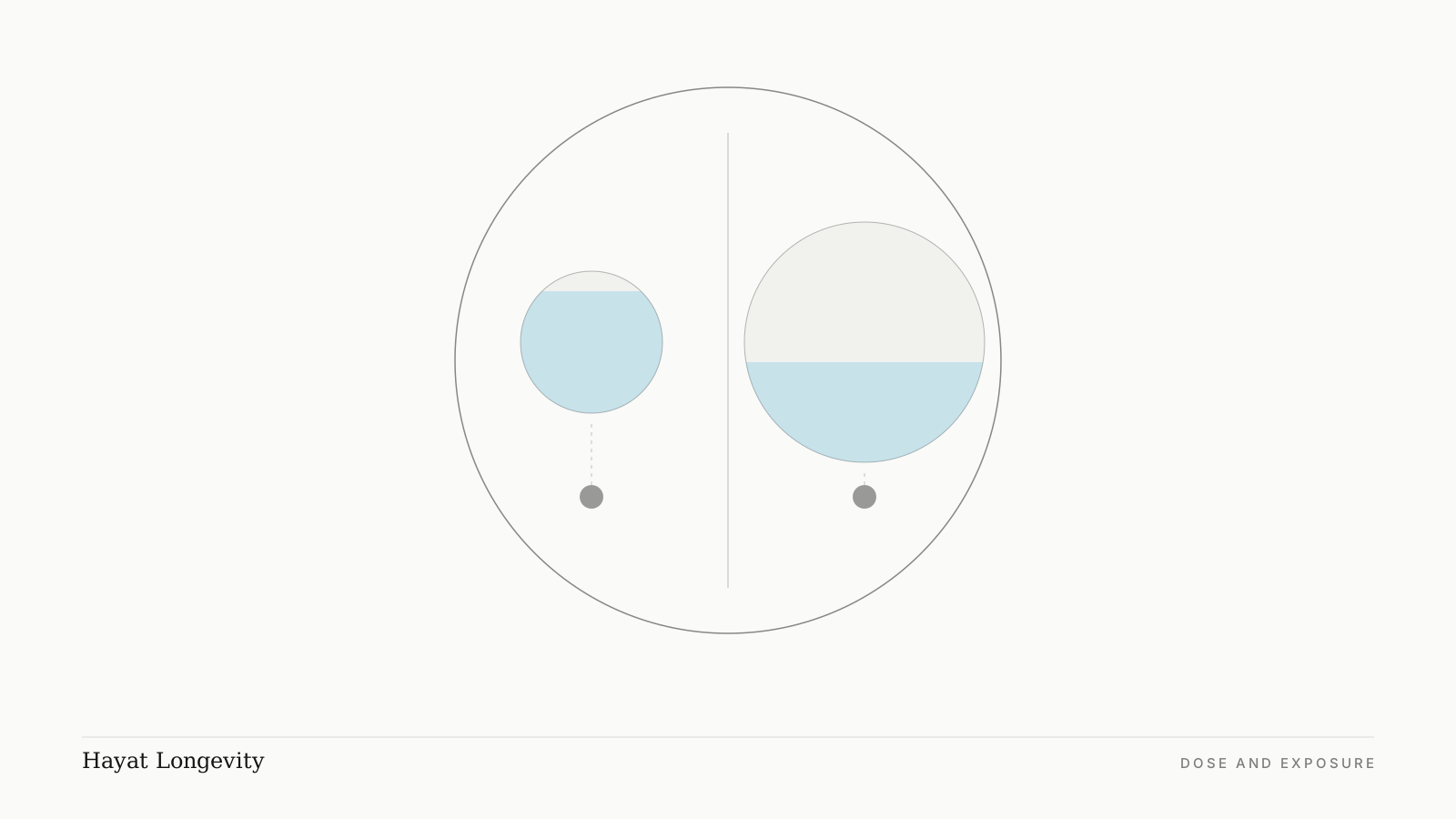
Exposure to these drugs depends on body weight. For a smaller-framed patient, the standard trial dose is not the same dose at all, and the objective may not be maximal weight loss.
One area I find increasingly interesting in metabolic medicine is dose individualisation with incretin therapy.
When these medicines are discussed, most of the major trials that inform the conversation enrolled patients with obesity or significant metabolic disease, and used the maximum tolerated dose. That is appropriate trial design, and it produced the outcome data the field now relies on.
But it leaves a question that trials of that shape were never built to answer: what happens when you use the lowest dose that produces a meaningful clinical response, in a patient whose objective is not dramatic weight loss?
Key takeaways
- Drug exposure is inversely related to body weight. A smaller-framed patient on a lower dose may reach the same exposure as a heavier trial participant on a standard dose.
- Lower doses are not inert. In STEP-2, semaglutide 1.0 mg produced around 7 per cent weight loss against 9.6 per cent at 2.4 mg. Both are approved doses.
- For a patient who is not carrying substantial excess fat, the objective should be recomposition, not driving the scale as low as possible.
- Trial body-composition data comes from maximum doses. Extrapolating it to lower doses is an assumption, and I will say so rather than imply otherwise.
- Lean mass fell in absolute terms in the STEP-1 analysis even as its proportion rose. In a leaner patient this remains the central risk.
- Without adequate protein and resistance training, a lower dose does not solve that problem. It only makes it smaller.
The pharmacokinetic argument, which is the strongest one
This is the part of the reasoning I would put first, because it is the least speculative.
Semaglutide exposure is influenced by body weight. Individuals with lower body weight generally achieve greater exposure at the same nominal dose, while higher body weight is associated with lower exposure. Studies in Asian populations point the same way: body weight is the important determinant, rather than ethnicity itself representing a major pharmacokinetic difference.
The practical consequence is worth stating plainly. A 55 kg patient and a 110 kg patient given the same dose are not receiving the same treatment. They are receiving substantially different exposures.
So when a smaller-framed patient is treated at a lower dose, that is not necessarily under-treatment. It may be the dose that delivers, in that person, an exposure comparable to what a heavier participant received in the trials. Framed that way, this is not exotic. It is the same principle that governs dosing in most of medicine, applied to a drug class where a fixed titration ladder has become the default.
This is why I am cautious about the word "microdosing". It implies deliberately sub-therapeutic treatment. What I am describing is finding the dose that produces the intended clinical effect in the patient in front of me, which in a smaller person may sit lower on the ladder than the trial maximum.
Lower doses are not inert
The evidence that lower doses do something is direct.
In STEP-2, semaglutide 1.0 mg produced approximately 7 per cent weight loss, against approximately 9.6 per cent with 2.4 mg. The higher dose was more effective. The lower dose still produced a clinically meaningful response.
One point of precision matters here, and it is often glossed over: 1.0 mg is an approved dose, licensed for type 2 diabetes. So this is evidence for using lower doses within approved ranges, not evidence for going below them. I am describing titration to the lowest effective dose, not dosing beneath what has been evaluated.
The same logic extends to dual agonism. Tirzepatide, acting through both the GIP and GLP-1 pathways, has demonstrated substantial effects on body weight, waist circumference, insulin sensitivity and body composition in SURMOUNT-1, and in SURMOUNT-5 produced greater average weight and waist reduction than semaglutide at maximum tolerated doses. Different patients may respond differently to different incretin pathways, which is a further argument for individualisation rather than a single default.
When the objective is recomposition rather than weight loss
Consider a patient with a relatively normal BMI who nonetheless carries disproportionate visceral fat, shows insulin resistance, struggles with appetite regulation, and cannot shift body composition despite training and eating reasonably well.
That patient does not need to lose fifteen per cent of their body weight. In many cases they should not. What they need is a smaller, better-targeted change: appetite regulation, visceral fat reduction, improved insulin sensitivity, and muscle preserved throughout.
The body-composition data is genuinely encouraging on the first part. The STEP-1 DEXA analysis showed roughly a 19 per cent reduction in total fat mass and around 27 per cent in regional visceral fat. Body-composition work with tirzepatide has shown a similar pattern, with reductions concentrated in fat mass including visceral adipose tissue.
Two honest qualifications on that data.
All of it comes from maximum-dose trials. Assuming the same favourable fat-to-lean ratio holds at lower doses is reasonable, but it is an extrapolation rather than a finding, and nobody has tested it directly.
And in STEP-1, lean mass fell in absolute terms. Its proportion of total body weight rose, which is the figure usually quoted, but the absolute loss was real. In a patient who is already lean, that is precisely the wrong direction, and it is the single strongest reason not to treat this class of drug casually in people without substantial excess fat.
This is why I do not regard the pharmacological part as the intervention. The intervention is:
a small pharmacological effect, plus adequate protein, plus resistance training, plus metabolic monitoring.
Remove any of the last three and you are simply making someone smaller, which is not the objective. Our article on protein and muscle after 40 covers why muscle is the tissue to defend, and visceral fat covers why the scale is a poor guide to the change you actually want.
Metabolic effects beyond weight
These drugs influence glucose regulation, insulin sensitivity, visceral adiposity and appetite signalling. Tirzepatide's dual receptor activity adds a further dimension, with trials showing improvements in glycaemic control, insulin resistance and body composition.
SELECT demonstrated a reduction in major cardiovascular events with semaglutide in adults with overweight or obesity and established cardiovascular disease, which is the outcome evidence that moved this class from weight management into cardiometabolic medicine.
There is also emerging interest in cognitive outcomes. Large observational and cohort studies have reported associations between GLP-1 receptor agonist use and lower rates of cognitive impairment and neurodegenerative disease, with similar signals now appearing for tirzepatide. These are observational associations, not trial results, and they are confounded in obvious ways: weight loss itself, the metabolic improvement, and the reasons people are prescribed these drugs in the first place. They open a genuine research question about insulin signalling, inflammation and vascular health in the brain. They are not a reason to take these medicines, and I would not present them as one.
Where this reasoning stops
I would rather state the limits than have someone else point them out.
There is no randomised trial of individualised low-dose therapy for body recomposition in patients with near-normal BMI. The pharmacokinetic argument is sound, the lower-dose efficacy data is real, and the recomposition rationale is coherent. That combination is a well-reasoned clinical position, not a proven one.
The body-composition benefits are extrapolated from maximum-dose studies, as above.
Lean mass loss remains the principal risk in leaner patients, and no dose adjustment removes it. It is managed with protein and resistance training or it is not managed at all.
And these drugs carry real adverse effects, which do not disappear at lower doses: gastrointestinal symptoms, pancreatitis, gallbladder disease, and delayed gastric emptying with implications for anaesthesia. There are firm contraindications, including personal or family history of medullary thyroid carcinoma or MEN2, prior pancreatitis, pregnancy, and a history of disordered eating.
Who this is, and is not, for
It may be appropriate for someone with demonstrated visceral adiposity, insulin resistance or impaired glycaemic control, whose appetite regulation is genuinely working against them, and who is prepared to train and eat for muscle preservation throughout.
It is not appropriate for someone who is metabolically healthy with normal body composition and simply wants to be leaner. In that patient there is nothing to correct, the lean mass consideration argues against it, and the honest answer is that training and nutrition will serve them better.
And it is not a substitute for assessment. Whether any of this applies to you is a question about your body composition, your metabolic markers and your history, not about the medicine.
How we approach it
Assessment first, and the assessment stands on its own merits regardless of what follows: body composition with lean mass quantified rather than weight alone, metabolic and lipid panel, glycaemic markers, and a review of history and contraindications.
Where treatment is indicated, we prescribe registered pharmaceutical products, titrate to the lowest dose that produces the intended clinical response rather than defaulting to the maximum, and build the protein and resistance training programme in from the start. Body composition is repeated at three and six months with lean mass as an explicit endpoint, because a protocol that tracks only total weight is not adequate for this objective.
Where assessment finds no indication, we say so. That is a useful result and it happens often.
Frequently asked questions
Why would a lower dose be appropriate?
Because exposure to these drugs is inversely related to body weight. A smaller-framed patient given a standard dose receives substantially higher exposure than a heavier trial participant on the same dose. A lower dose in that patient may deliver comparable exposure, which is dose individualisation rather than under-treatment.
Is this the same as microdosing?
No, and I avoid the term. Microdosing implies deliberately sub-therapeutic treatment, often in people with no clinical indication. What I am describing is titration to the lowest dose that produces the intended clinical effect, within approved ranges, in patients who have an indication.
Do lower doses actually work?
Yes, though less than maximum doses. In STEP-2, semaglutide 1.0 mg produced around 7 per cent weight loss against 9.6 per cent at 2.4 mg. Worth noting that 1.0 mg is itself an approved dose, so this is evidence for lower doses within approved ranges rather than for going below them.
Will I lose muscle?
Some lean mass loss occurs with weight loss on this class of drug. In the STEP-1 analysis, lean mass fell in absolute terms while rising as a proportion of body weight. In a patient who is already lean this is the central risk, and the countermeasure is adequate protein and resistance training rather than a dose adjustment.
Is this suitable if I am not overweight?
Usually not. If your body composition and metabolic markers are unremarkable, there is nothing to correct and the lean mass consideration argues against treatment. Where a near-normal BMI conceals visceral adiposity or insulin resistance, that is a different situation, and it is established by measurement rather than by appearance.
Does it improve brain fog or cognition?
The evidence does not support saying so. Large observational studies have reported associations between this drug class and lower rates of cognitive impairment, but they are observational, confounded by weight loss and by the reasons people are prescribed these medicines, and they concern diagnosed disease rather than everyday symptoms. It is an interesting research question, not a reason to start treatment. Written by Dr. Daniel Chong, Human Performance and Longevity. AOKLINIK Penang. General information only and not individual medical advice. The medicines discussed are prescription-only, carry significant contraindications and adverse effects, and require assessment, prescription and monitoring by a doctor familiar with your full medical history. Do not obtain or use these medicines without medical supervision. Specific products and dosing are deliberately not detailed here and are a matter for consultation.
References
- Wilding JPH, et al. Once-weekly semaglutide in adults with overweight or obesity (STEP 1). New England Journal of Medicine, 2021.
- STEP 1 DEXA body-composition substudy: reductions in total fat mass and regional visceral fat mass, with lean mass falling in absolute terms while increasing as a proportion of total body weight.
- Davies M, et al. Semaglutide 2.4 mg once a week in adults with overweight or obesity and type 2 diabetes (STEP 2). The Lancet, 2021.
- Lincoff AM, et al. Semaglutide and cardiovascular outcomes in obesity without diabetes (SELECT). New England Journal of Medicine, 2023.
- Jastreboff AM, et al. Tirzepatide once weekly for the treatment of obesity (SURMOUNT-1). New England Journal of Medicine, 2022.
- Aronne LJ, et al. Tirzepatide as compared with semaglutide for the treatment of obesity (SURMOUNT-5). New England Journal of Medicine, 2025;393(1):26-36.
- Semaglutide population pharmacokinetic analyses: body weight as a determinant of exposure.
- Observational cohort studies reporting associations between GLP-1 receptor agonist exposure and lower rates of cognitive impairment and neurodegenerative disease.